Anthony Scaramucci (Author)
An explosive insider story of the biggest mistakes in history and how to put them right — from the man who saw America’s wrong moves up close, White House insider turned host of the hit podcast, The Rest is Politics: US
We’re living in an age of deep political anger and frustration. Where did it come
from, and how do we get out?
Anthony Scaramucci’s electrifying answer – rooted in history, business, and first-hand experience – reveals the true origins of America’s current crisis, charting how both political parties made a series of catastrophic decisions that dismantled a postwar period of unprecedented stability and prosperity. Each decision deepened inequality, corroded trust, and fueled the anger that empowered Donald Trump’s rise and his assault on democracy.
The story Scaramucci tells is ‘money-point-of-view history’: it gallops from Wall St to Main St, from the boardroom to the Situation Room. A product of the working class who rose to the heights of finance and power, he has witnessed first-hand how money and ambition have always lived in tension with ideals. And he brings a rare skin-in-the game perspective to showing how both parties failed the people they once represented.
It will take courage and tough action but in All The Wrong Moves he sets up the challenge to cut through partisanship and embrace some right ones.
All the Wrong Moves is not about right and left. It’s about right and wrong. It is a portrait of America which has the clarity of an X-ray and is a blistering display of storytelling and analysis.
Lani Watson (Author)
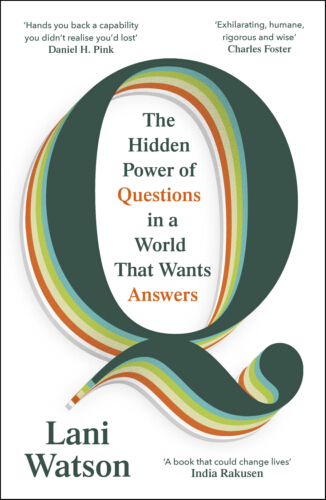
Our lives are shaped by questions: they are how we connect, persuade and flourish. But we live in a world that wants answers.
Questions are engines of learning, catalysts for connection, and drivers of change. They direct our attention and make us feel closer to loved ones and strangers alike. In fact, we are the only species that truly asks questions of one another.
But school trains us to answer, not ask. Workplaces reinforce that, and technology feeds us solutions before we’ve described the problem. The result is that we live in an answer-rich, question-poor world. Yet, from doctors’ surgeries to courtrooms to dating, the ability to ask questions determines our experiences. In a world obsessed by answers, asking better questions is powerful.
Q takes us on a transformative journey into the art and science of questioning and will shift your perspective on the world. In a captivating narrative from the death of Socrates to the age of AI, Lani Watson draws on research in psychology, philosophy and neuroscience to show how questions play a vital role in our individual lives and in our shared human story.
Q will make you think about the questions you ask and the ones you don’t. It is a life-enhancing invitation to harness the hidden power of our most underappreciated human skill.
Rachel Morley (Author)
A transporting and gloriously entertaining journey through the hidden lives of England’s rural parish churches – from building conservator and church ‘rescuer’ Rachel Morley
The poet John Betjeman coined the phrase ‘church crawling’ to describe his days out visiting churches. In the spirit of Betjeman, Rachel Morley’s book captures the magical experience of poking around a dusty village church, only to have it transform – through her expert eyes – into a portal to the past, one that brings England’s people and history to life in the most colourful, moving and unexpected ways.
Through their wall-paintings and monuments, their graffiti and plaques, their jumble of furniture and curios, Morley shows these buildings to be the expression of centuries of communal memory and folk culture – time capsules of connection to ancient and medieval ways of thinking, to revolutions and wars, to lives both glorious and humble. Along our journey we meet the Lincolnshire hermit who squeezed a devil from a man with his belt, the lovers struck by lightning before they could get married and the rope-sliding steeplejack who flew from a spire – before falling to his death. We discover the folk cure, ‘poor man’s aspirin’, and how it explains the gashes in church walls, we follow Victor Frankenstein into a charnel house to collect parts for his monster, and we learn how Thomas Hardy’s heart got eaten by a cat.
Too many of England’s fifteen thousand parish churches are now neglected and crumbling. Church Crawling helps us to see them for what they really are: places that thrum with the drama of life, and an incomparable treasure trove that offers as close an encounter with our past as it is possible to get.
Ben Dark (Author)
Most of life on Earth is plant. And yet the half a million species of plant alive today are a minuscule fraction of those that have ever existed. The true story of the plant kingdom’s almost inconceivable variety and ingenuity is to be found in the past.
From the arrival of the first plants on land 484 million years ago to the globe-spanning diversity of flora we know today, Green Kingdom traces the evolution of plant life across eons and continents, reanimating the lost worlds that shaped its course and dramatically expanding our vision of what it means to be a plant.
Through the stories of sixteen plant families, from the humble bog moss to the exquisite adaptations of the orchid, we witness how plant life colonised land, pioneered leaves, recruited fungi, invented wood, sunk roots, formed seeds, manipulated animals and ultimately came to dominate our planet. Some take us to unrecognisable Earths, to a world buried under twelve thousand years of ice, or hidden in the blackout of an asteroid winter. Each represents a response to a defining event in the planet’s history, from volcanic chain eruptions and sudden glaciations to the gradual parting of continents. Along the way we swim with eel grass, meet desert succulents that live for millennia, marvel at duckweed, the only plant that seasonally migrates, discover the secret to buttercups’ iridescence and why 99.5% of life was once fern.
Inhabiting the lives and minds of the adventurers, poets, philosophers and scientists who pieced this epic story together and bringing the wonder and stupendous variety of plants to life as never before, Green Kingdom is both a hidden history of the Earth and a dynastic drama, as rich and unexpected as any story ever told.
Kevin Fong (Author)
Kevin Fong, doctor, expert in major-incident planning and response, and writer-presenter of the hit podcast 13 Minutes to the Moon, shares crucial insights into teamwork, crisis management and resilience in this essential survival guide for an uncertain world.
No plan survives the first five minutes of contact with reality – so how should we prepare for what follows?
Kevin Fong has spent his working life in high-risk, high-performance teams – flying as a Helicopter Emergency Medical Service doctor, working with NASA’s human spaceflight programme, as well as being part of the UK’s frontline response to major incidents and terror attacks. Told through gripping stories of the most challenging, high-pressure emergencies across medicine, aviation and spaceflight, Minute Six provides crucial, counter-intuitive insights into how the best teams and organisations succeed against the odds, learn from failure and go again.
As Fong shows, decisions in the face of irreducible uncertainty are the ultimate team sport and their success depends wholly on the wider systems that support them. He exposes the key principles for designing those systems: distributed leadership, deference to expertise, delegation of authority, graceful failure, embracing complexity and finding the right balance between humans and technology. The ultimate lessons are these: never lose sight of the humans in the loop, and when it comes to managing fast-moving threats in the face of the unknown, the edge of chaos is exactly where you need to be.
Combining hard-won expertise with superb storytelling, Minute Six is the essential survival guide for an ever-more volatile and uncertain world.
James Marriott (Author)
Books are dying. Across the world the number of people reading is in free fall. Literacy is declining or stagnating in most developed countries. At universities, students are unable to read the books assigned to them by their teachers. Addictive digital entertainment technologies have colonised our free time with infantilising ‘slop’. The golden chain of knowledge linking reader to reader through the centuries is breaking for the first time since the collapse of the Western Roman Empire ushered in the Dark Ages.
The New Dark Ages is an impassioned attack on the trivial and meaningless culture of the screen and a defence of the written word. Drawing on history and classic works of literature and theory, The New Dark Ages argues that reading and writing are essential for innovation, creativity and critical thinking.
Above all, the culture of print is essential to the functioning of modern democracies which require their citizens to grapple with ideas at length and in depth. And as print dies, we risk returning to the chaos, tribalism, and rage of a pre-literate society.